01 / 06·2025 – 2026
ModelLabAI
Zero-code AI analytics: any business file in, dashboards and answers out.
- Role
- Design, full stack, ML service, CI
- Source
- Private repo
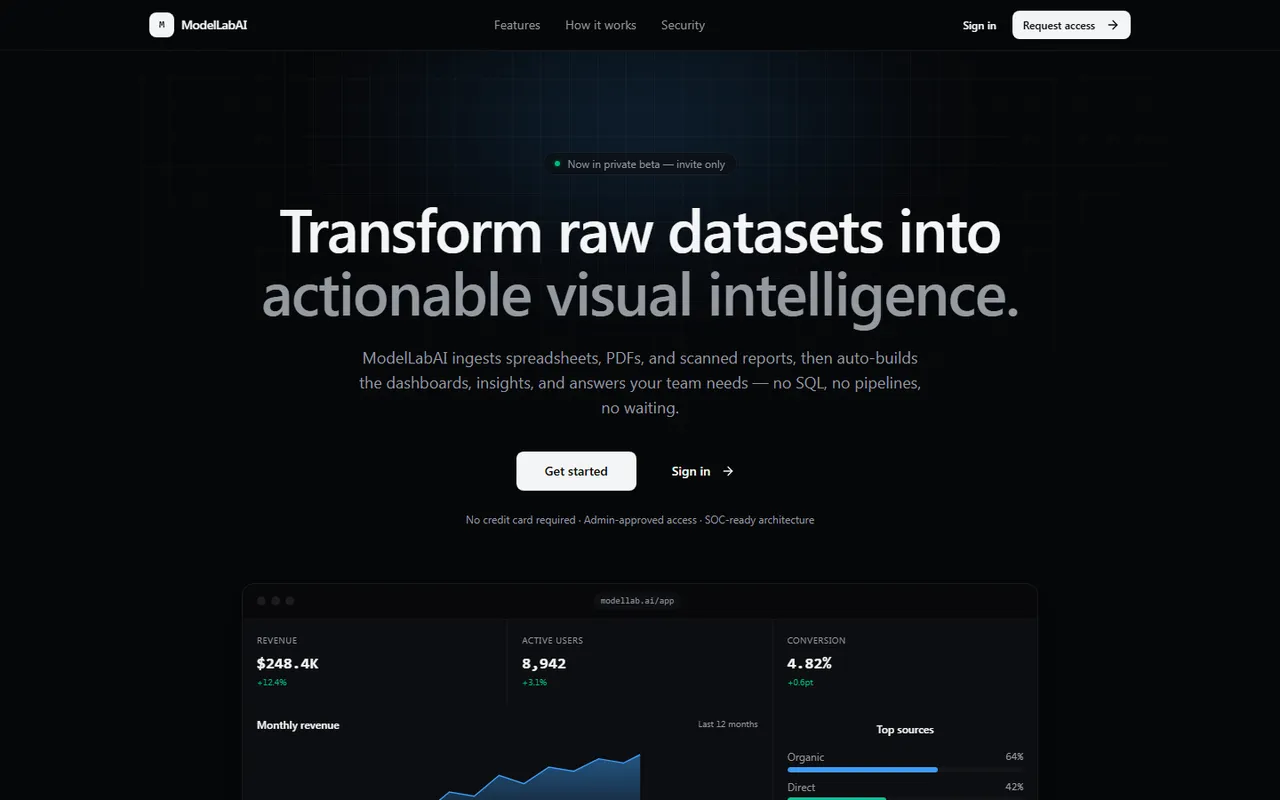
01
Context & my role
My own product, built as the successor to ModelLab, the no-code model trainer behind the IJSRET 2024 paper.
I owned it end to end: product scope, the React app, 32 edge functions, the Python ML service and CI.
Role: Design, full stack, ML service, CI
00
At a glance
CSV · Excel · PDF · imageInput
upload or connector sync
Schema inference + OCRProcess
Deno edge functions
KPIs + anomaly detectionProcess
FastAPI · scikit-learn
LLM chat over the datasetAI step
context compressed per call
Row-level security per orgGuardrail
tenancy enforced in Postgres
Dashboards, reports, answersOutput
How the system works, top to bottom. Accent steps call a model; dashed steps are rules enforced in code, so the model cannot override them.
AI step Guardrail enforced in code Processing
02
Problem
Most teams generate more data than they can act on. The gap between “data exists” and “a decision gets made” is an analyst bottleneck, a BI tool that needs IT to set up, and operational data split across CSV exports, spreadsheets, scanned PDFs and screenshots.
ModelLabAI is the successor to ModelLab (the no-code model trainer behind the IJSRET 2024 paper). The question changed from “can a non-engineer train a model?” to “can a non-engineer get an answer from their data in minutes, in any format?”
03
Approach
A React 19 single-page app (Vite, TanStack Query for all server state, Zustand for session/org) talks only to Supabase: Postgres with row-level security, Auth, Storage and Realtime.
All backend logic lives in 32 Deno edge functions grouped by concern — ingestion, AI, data connectors, sharing, billing, reports and access. Shared utilities handle CORS, schema inference, credential encryption and OAuth token refresh.
Heavier dataset intelligence runs in a separate Python FastAPI service on Railway. The `analyze-dataset-ml` edge function calls it and stores the result; the ML service never touches the database directly.
04
Architecture
ModelLabAI Analytics & Document Intelligence
simplified, illustrativeFull-stack AI analytics platform converting unstructured files into executive dashboards with hybrid vector search and scikit-learn analytics.
System Overview & Accessible Text Description
Components: React 19 Client (client); FastAPI Processing Service (service); Document Ingestion Engine (worker); OpenAI API (llm); Supabase pgvector Store (db); Analytics & ML Engine (worker); Supabase Auth & RLS (service).
Key Data & Auth Flows: React 19 Client → FastAPI Processing Service [Upload File / Query]; FastAPI Processing Service → Document Ingestion Engine [Extract Tabular Data]; Document Ingestion Engine → OpenAI API [Generate Vectors]; OpenAI API → Supabase pgvector Store [Save Embeddings]; FastAPI Processing Service → Analytics & ML Engine [Compute KPIs]; Analytics & ML Engine → React 19 Client [Dashboard JSON]; React 19 Client → Supabase Auth & RLS [User Session].
05
Key decisions & trade-offs
- 01Backend logic lives in Supabase edge functions; heavier ML runs in a separate FastAPI service that never touches the database. One more service to deploy, in exchange for keeping Python ML away from tenant data access.
- 02Postgres row-level security is the tenancy boundary, not application code, so a missed check in a function cannot leak another org's data.
- 03Chat over a dataset compresses context before each LLM call so large tables stay inside the model window; insight generation is a separate function so results can stream in.
- 04Connector credentials are encrypted at rest with OAuth token refresh, and sync jobs go through a queue with connection tests instead of running inline.
06
Outcome
- Live in production at modellabai.rushil-salian.com.
- Replaced a single-purpose model trainer with a multi-tenant analytics product — the same codebase now serves upload-to-dashboard, scheduled reporting and conversational analysis.
07
Stack
- React 19
- TypeScript
- Vite
- TanStack Query
- Zustand
- Tailwind
- Supabase
- Deno
- OpenAI
- Python
- FastAPI
- scikit-learn
- GitHub Actions
Services involved
Skills evidenced: React · TypeScript · Next.js · Supabase · PostgreSQL · OpenAI API · RAG · Embeddings · scikit-learn · Python · GitHub Actions · CI/CD · RBAC
Next case study
Worklogs →
Daily notes in, Kimai timesheets out — with an intelligence layer on top.